01 / THE INVESTMENT THESIS
Fundamentals
Start with the useful thing being built—and ask whether its token benefits.
Explore this lens ↗Connecting to Coinbase · Automatic refresh every 60 seconds

Beyond the hype, there’s structure. Fundamentals first. Network signals next. Charts that put the bigger picture in focus.
Our strongest cases for long-term relevance—with the risks and the evidence that could change the ranking.
Explore the Top 5 ↗One chart never tells the whole story. Look for agreement across the signals.
Start with the useful thing being built—and ask whether its token benefits.
Explore this lens ↗Follow the network. Examine activity beyond the price on a screen.
Explore this lens ↗Map trends, key levels, and Fibonacci zones—without the mysticism.
Explore this lens ↗Bitcoin does not need to replace every bank or currency. The optimistic case is that more people come to value a monetary asset no single issuer controls.
Bull thesis · Neutral outlook · Bear caseRead the fundamentals ↗The optimistic Ethereum thesis is about useful economic activity: more assets, payments, and agreements settling on programmable infrastructure—and a meaningful role for ETH within it.
Bull thesis · Neutral outlook · Bear caseRead the fundamentals ↗The positive Solana thesis is that useful applications can turn occasional visitors into returning users—and make the network’s native asset economically relevant beyond the trading cycle.
Bull thesis · Neutral outlook · Bear caseRead the fundamentals ↗Memecoins, new launches, rug pulls, and the difference between an exciting chart and a survivable risk.
Investor education · Risk & disciplineRead the article ↗A regular buying plan can make volatile markets easier to navigate. Asset quality and position size still come first.
Investor education · Risk & disciplineRead the article ↗The market changes its story with the price. A misspelled forum post offers a surprisingly useful lesson in how to respond.
Illustrated guide · The original HODL storyExplore the cycle ↗New assets. Familiar emotions. Fear, greed, patience, and conviction leave traces in every market. Pattern Crypto explores where those behaviors meet technology—and what a longer perspective lets us see.
The asset, its economic role, and the assumptions behind the investment case.
Our strongest cases for long-term relevance—with the risks and the evidence that could change the ranking.
Explore the Top 5 ↗Scarce money. Programmable settlement. Everyday applications. The differences matter.
The monetary thesis.
Bitcoin is a peer-to-peer monetary network secured by proof-of-work. Its rules limit total issuance to 21 million BTC, with new supply declining through scheduled halvings.
Its appeal is portable scarcity: an asset people can hold and transfer without a central issuer. The investment case depends on continued demand for those monetary properties, rather than profits from an operating company.
Scarcity does not set a price floor. Bitcoin generates no dividend for simply holding it, and demand can weaken sharply. Custody mistakes, leverage, and changes in access add risks beyond the protocol itself.
Bitcoin is best evaluated as a monetary asset, not as a technology stock. The key question is whether more people continue to value its independence and predictable supply. A halving reduces new issuance; it does not guarantee new buyers. Our view: the strongest thesis pairs a durable demand argument with an honest tolerance for volatility.
Source: Bitcoin.org — FAQ
The settlement thesis.
Ethereum is a programmable blockchain. ETH pays network transaction fees and helps secure the network through staking. Applications can use its shared infrastructure for payments, lending, and digital assets.
ETH connects to network use through fees and staking. Ethereum burns base transaction fees while issuing rewards to validators; supply can expand or contract depending on the balance. It is not permanently deflationary.
More applications do not automatically mean a higher ETH price. Cheaper execution and competing networks can limit fee demand. Staking also introduces operational risks, while using applications adds separate smart-contract risks.
The investment case is that useful economic activity sustains demand for Ethereum’s infrastructure and its native asset. Our view: adoption matters most when it also strengthens settlement demand and token economics. ETH is not equity in every application built on Ethereum, and growth in the ecosystem is not a guaranteed return to holders.
Source: Ethereum.org — What is ether? · Ethereum.org — ETH issuance
The application thesis.
Solana is a programmable blockchain whose transactions require fees in SOL. Holders can delegate stake to validators, linking the native asset to both network use and network security.
The investment thesis centers on applications people use repeatedly: payments, trading, and other digital services. If usage becomes durable, it can support demand for transaction capacity and the asset that helps secure it.
SOL has ongoing inflation rather than Bitcoin’s fixed supply ceiling. Staking rewards must be considered alongside dilution. Cheap transactions can encourage activity without generating substantial fees, and automated traffic can exaggerate apparent adoption.
The useful test is whether users keep returning when incentives and speculation fade. Our view: rising transaction counts alone are insufficient; retained users, fee demand, reliability, and validator economics make a stronger case. A successful application ecosystem would help the thesis, but competition and token issuance still matter to what holders ultimately earn.
Source: Solana documentation — Fees · Solana — Staking
Asset profiles · Reviewed September 18, 2026 · “Our view” identifies editorial analysis.
Bitcoin does not need to replace every bank or currency. The optimistic case is that more people come to value a monetary asset no single issuer controls.
Bull thesis · Neutral outlook · Bear caseRead the fundamentals ↗The optimistic Ethereum thesis is about useful economic activity: more assets, payments, and agreements settling on programmable infrastructure—and a meaningful role for ETH within it.
Bull thesis · Neutral outlook · Bear caseRead the fundamentals ↗The positive Solana thesis is that useful applications can turn occasional visitors into returning users—and make the network’s native asset economically relevant beyond the trading cycle.
Bull thesis · Neutral outlook · Bear caseRead the fundamentals ↗Start with the risks of new coins, build a buying discipline, then examine ten more asset theses.
Memecoins, new launches, rug pulls, and the difference between an exciting chart and a survivable risk.
Investor education · Risk & disciplineRead the article ↗A regular buying plan can make volatile markets easier to navigate. Asset quality and position size still come first.
Investor education · Risk & disciplineRead the article ↗The market changes its story with the price. A misspelled forum post offers a surprisingly useful lesson in how to respond.
Illustrated guide · The original HODL storyExplore the cycle ↗A research-led network has a compelling opportunity—if careful engineering becomes useful everyday activity.
Bull thesis · Neutral outlook · Bear caseRead the fundamentals ↗The strongest infrastructure often works out of sight. Can reliable data and connectivity translate into durable LINK demand?
Bull thesis · Neutral outlook · Bear caseRead the fundamentals ↗Predictable network costs could attract practical use. The harder question is how much value reaches HBAR.
Bull thesis · Neutral outlook · Bear caseRead the fundamentals ↗The opportunity is a useful application economy. The test is whether users stay after the incentives stop.
Bull thesis · Neutral outlook · Bear caseRead the fundamentals ↗Real-world assets are a powerful theme. Owning ONDO is a distinct proposition that needs its own evidence.
Bull thesis · Neutral outlook · Bear caseRead the fundamentals ↗Useful payment rails can create lasting relevance. XLM still needs an economic case of its own.
Bull thesis · Neutral outlook · Bear caseRead the fundamentals ↗Fast movement of value is useful. The investment question is whether that usefulness requires sustained XRP demand.
Bull thesis · Neutral outlook · Bear caseRead the fundamentals ↗An information-rich world needs provenance. Can a decentralized knowledge graph turn that need into paid demand?
Bull thesis · Neutral outlook · Bear caseRead the fundamentals ↗A straightforward payments asset can have a role without becoming the center of every new crypto narrative.
Bull thesis · Neutral outlook · Bear caseRead the fundamentals ↗The Artificial Superintelligence Alliance brings an ambitious vision. The investment case still needs real customers.
Bull thesis · Neutral outlook · Bear caseRead the fundamentals ↗Buying a token does not generally give you ownership of the applications that use its blockchain. Revenue can flow to an application, an issuer, or a service provider without flowing proportionately to the network’s token holders.
Bitcoin’s supply rules explain scarcity. They do not explain how strongly people will want it at a particular price. A monetary thesis needs a demand argument as well as a supply argument.
ETH has network functions, including fees and staking. The investment question is whether demand for those functions and the balance of issuance and burning support the price being paid.
SOL also connects usage with fees and staking. Cheap transactions can support useful applications, but token holders must still consider supply growth and how much economic demand activity creates.
A useful asset can be overvalued. A convincing long-term story does not remove the possibility of a poor entry price, a deep drawdown, or years of disappointing returns.
Public blockchain activity can test a narrative. It cannot tell you every user’s identity, purpose, or intention.
One person can operate many addresses; a service can represent many customers. Growth is more informative when it appears alongside recurring usage and a clear economic purpose.
Coins can move between wallets controlled by the same owner. Exchange transfers, internal reorganizations, and automated activity may inflate raw transaction totals.
Fees show what users spend for network capacity. Low fees can be good for adoption, while higher fees can indicate demand or congestion. Neither interpretation works in isolation.
An incentive program can attract capital and transactions that leave when rewards end. Retention after the incentive changes is stronger evidence than a peak during the campaign.
| Asset | Useful lens | What it cannot prove |
|---|---|---|
| BTC | Coin movement, holding behavior, and exchange-related activity can add context to the monetary thesis. | A transfer toward an exchange is not proof that its owner will sell. |
| ETH | Fees, staking, issuance and burning connect activity to the asset’s economic role. | A rise in ecosystem activity is not a guarantee of a proportional increase in demand for ETH. |
| SOL | Fee-paying activity, user retention, and validator economics help test the application thesis. | A large transaction count does not establish that the activity represents independent, paying users. |
First ask whether the measurement changed. Then identify which applications contributed the growth, whether the users returned, and whether fees or economic value grew with the activity. A single large number is a clue, not a conclusion.
Background: Bitcoin.org FAQ; Ethereum.org ETH and issuance documentation; Solana transaction-fee and staking documentation. Interpretation is editorial, not a current network assessment.
Follow BTC, ETH, and SOL in USD, then separate price movement from business and network fundamentals.
See the movement. Then return to the thesis behind it.
A volatile day can look ordinary across a year. Compare 24-hour, weekly, monthly, quarterly, and yearly views. The shorter two use hourly candles; longer views use daily candles.
Candlesticks show open, high, low, and close. Volume bars show units of the selected asset traded on Coinbase during each interval. They are not total global volume or order-book depth.
Linear spacing compares dollar changes; log spacing compares proportional changes. The 20-period simple moving average smooths closing prices. It lags the market and is not a trading signal by itself.
The feed uses Coinbase USD pairs. Prices can differ across exchanges, and this chart does not represent a blended global market price.
Dated reporting, original analysis, and clear distinctions between what happened and what might follow.
Our strongest cases for long-term relevance—with the risks and the evidence that could change the ranking.
Explore the Top 5 ↗No articles match. Try another term or clear the filters.
BTC, ETH, SOL, LINK, AAVE: why they belong and what would change the ranking.
Explore the ranking ↗The market changes its story with the price. A misspelled forum post offers a surprisingly useful lesson in how to respond.
Illustrated guide · The original HODL storyExplore the cycle ↗Bitcoin does not need to replace every bank or currency. The optimistic case is that more people come to value a monetary asset no single issuer controls.
Bull thesis · Neutral outlook · Bear caseRead the fundamentals ↗The optimistic Ethereum thesis is about useful economic activity: more assets, payments, and agreements settling on programmable infrastructure—and a meaningful role for ETH within it.
Bull thesis · Neutral outlook · Bear caseRead the fundamentals ↗The positive Solana thesis is that useful applications can turn occasional visitors into returning users—and make the network’s native asset economically relevant beyond the trading cycle.
Bull thesis · Neutral outlook · Bear caseRead the fundamentals ↗Memecoins, new launches, rug pulls, and the difference between an exciting chart and a survivable risk.
Investor education · Risk & disciplineRead the article ↗A regular buying plan can make volatile markets easier to navigate. Asset quality and position size still come first.
Investor education · Risk & disciplineRead the article ↗A research-led network has a compelling opportunity—if careful engineering becomes useful everyday activity.
Bull thesis · Neutral outlook · Bear caseRead the fundamentals ↗The strongest infrastructure often works out of sight. Can reliable data and connectivity translate into durable LINK demand?
Bull thesis · Neutral outlook · Bear caseRead the fundamentals ↗Predictable network costs could attract practical use. The harder question is how much value reaches HBAR.
Bull thesis · Neutral outlook · Bear caseRead the fundamentals ↗The opportunity is a useful application economy. The test is whether users stay after the incentives stop.
Bull thesis · Neutral outlook · Bear caseRead the fundamentals ↗Real-world assets are a powerful theme. Owning ONDO is a distinct proposition that needs its own evidence.
Bull thesis · Neutral outlook · Bear caseRead the fundamentals ↗Useful payment rails can create lasting relevance. XLM still needs an economic case of its own.
Bull thesis · Neutral outlook · Bear caseRead the fundamentals ↗Fast movement of value is useful. The investment question is whether that usefulness requires sustained XRP demand.
Bull thesis · Neutral outlook · Bear caseRead the fundamentals ↗An information-rich world needs provenance. Can a decentralized knowledge graph turn that need into paid demand?
Bull thesis · Neutral outlook · Bear caseRead the fundamentals ↗A straightforward payments asset can have a role without becoming the center of every new crypto narrative.
Bull thesis · Neutral outlook · Bear caseRead the fundamentals ↗The Artificial Superintelligence Alliance brings an ambitious vision. The investment case still needs real customers.
Bull thesis · Neutral outlook · Bear caseRead the fundamentals ↗Hundreds of obituaries later, the critics have not disappeared. But there is a better argument to have than whether the next price crash is the funeral.
Read the article ↗A failed Senate procedural vote leaves the broader market-structure bill stalled. For investors, the distinction between a favorable policy climate and durable legislation matters.
Read the article ↗The stablecoin framework has moved beyond a legislative promise. Licensing and implementation now matter—and a larger digital-dollar economy would not automatically enrich every token holder.
Read the article ↗A failed Senate procedural vote leaves the broader market-structure bill stalled. For investors, the distinction between a favorable policy climate and durable legislation matters.
On September 15, the Senate rejected cloture on the motion to proceed to H.R. 3633, the CLARITY Act, by 49–50. This was a procedural vote, not a final vote on passing the bill. Source: U.S. Senate, roll-call vote 234, September 15, 2026
The legislation concerns the regulation of digital commodities by the SEC and CFTC. The Senate result means that this attempt to advance it did not succeed; it does not, by itself, erase existing law or settle every token’s treatment. Nor is a failed procedural vote proof that legislation can never return.

A financial business planning custody, trading, or token issuance needs to understand which obligations will apply. Uncertainty can make long-term commitments harder to price. Investors should therefore distinguish a company’s ability to operate today from the durability of the rules underlying its plans.
For BTC, ETH, and SOL, the vote is a policy development rather than a direct change to network supply or transaction mechanics. Its investment relevance is indirect: the conditions under which businesses may connect those networks to customers and capital. There is no automatic formula from a Washington setback to a token’s fair value.
Watch for a renewed legislative path and the actual text of any future proposal. Until then, treating hoped-for passage as an accomplished fact builds an investment thesis on something that has not happened. Political optimism is an input; it is not a substitute for enacted rules.
Original Pattern Crypto analysis based on the official Senate record. Policy status checked September 18, 2026.
The stablecoin framework has moved beyond a legislative promise. Licensing and implementation now matter—and a larger digital-dollar economy would not automatically enrich every token holder.
The GENIUS Act became law on July 18, 2025. On August 17, 2026, Treasury proposed rules concerning payment-stablecoin issuance, offering, and sale. Source: Public Law 119-27, July 18, 2025 · Source: U.S. Treasury, August 17, 2026
Treasury’s August notice identifies January 18, 2027 as the expected effective date and explains the coming federal or state licensing requirement for U.S. issuance. That notice is a proposal, not a final rule. The statute sets effectiveness at the earlier of 18 months after enactment or 120 days after specified final implementing regulations. Source: GENIUS Act, section 20

A clearer framework could make it easier for businesses to evaluate digital-dollar products. But a payment stablecoin is designed to maintain a fixed monetary value, not to appreciate like a speculative asset. The potential business opportunities sit around issuance, distribution, custody, payments, and the infrastructure used to move those dollars.
For Ethereum and Solana, the possible connection is additional settlement activity. That is a thesis to test, not a guaranteed outcome. More stablecoin transfers could coexist with very low fees, leaving relatively modest demand for the underlying network token. Bitcoin’s monetary thesis is a different proposition again.
Follow final rules, licensing decisions, and products customers actually use. The useful question is where recurring economic value lands: with issuers, service providers, network operators, or token holders. A favorable policy headline does not answer that question on its own.
Original Pattern Crypto analysis. GENIUS is enacted; the cited Treasury implementation measure is proposed. Status checked September 18, 2026.
Founded and directed by James Clayton—a crypto community builder, Expanse co-founder, and investor whose involvement began in 2013.
In 2013, James founded Cryptocurrency Collectors Club, building a community that grew to approximately 130,000 members. His involvement began when crypto was still finding its audience—and when explaining the possibilities was as important as understanding the technology.
He went on to co-found Expanse, an early Ethereum fork, gaining firsthand experience on the project side of the industry as well as the community side. By the time he stepped away from the crypto industry in 2018, he had seen how technology, conviction, speculation, and human behavior could shape the same market in very different ways.
His perspective also draws on a career in programming and technical systems, including military explosion suppression and life-safety systems for hospitals and high-rise buildings. Running Mid Century Gallery for roughly nine years added another kind of experience: evaluating assets, recognizing quality, and understanding the distance between an asking price and lasting value.
Pattern Crypto brings those interests together. James sets the editorial direction, chooses the questions, and uses AI to help develop the research and writing. The focus is practical: what is being built, who uses it, and why should the token benefit?
Founded Cryptocurrency Collectors Club, beginning an early chapter in crypto education, discussion, and community building.
Co-founded Expanse, an early Ethereum fork, before stepping away from the crypto industry in 2018.
Bringing that background into a research publication focused on fundamentals, evidence, and market behavior.
Give promising ideas a fair hearing. Examine their economics. Make room for the bear case. Change the conclusion when the evidence changes.
Biographical background and community size supplied by James Clayton. Community size is approximate, not a live membership count.
Legislative reporting identifies the event and distinguishes a proposal from enacted law. A dated article stays tied to its review date rather than presenting itself as live news.
“Our view” and “Our analysis” identify editorial judgments. Conclusions can change when evidence changes; neither a strong story nor a familiar chart pattern guarantees a return.
Price data identifies its provider and units. On-chain guidance explains possible confounders. We do not substitute invented metrics when a live feed is unavailable.
Source names and relevant dates are provided as plain text. There are no outbound reading links. The market feed still contacts Coinbase to retrieve price data.
The market changes its story with the price. A misspelled forum post offers a surprisingly useful lesson in how to respond.
At the top, patience suddenly looks foolish. Everyone seems to know someone who made a fortune, and yesterday’s ambitious price target becomes today’s conservative one. At the bottom, the same asset can feel embarrassing to own. The technology may not have changed nearly as much as the conversation around it.
Bitcoin is a useful example because its story combines monetary conviction with intense speculation. Understanding that combination does not reveal the next turning point. It can help explain why your own decisions may feel most urgent when they deserve the most scrutiny.
Satoshi Nakamoto’s 2008 whitepaper proposed peer-to-peer electronic cash, and the network began operating in 2009. The starting point was a way to transfer value without a central payment intermediary. The later investment story added scarcity, savings, and the possibility that a growing number of people would want to hold the asset.
A price rise can bring attention. Attention brings new buyers, promoters, leverage, and more persuasive stories. Real progress and speculation can reinforce each other. The danger comes when rising prices are treated as sufficient evidence that every claim is true.
Disbelief can become curiosity, curiosity can become conviction, and conviction can become euphoria. During the climb, it becomes easier to imagine the upside and harder to imagine needing the money. During the decline, that balance reverses. A plausible long-term thesis suddenly feels less persuasive than the red number on the screen.
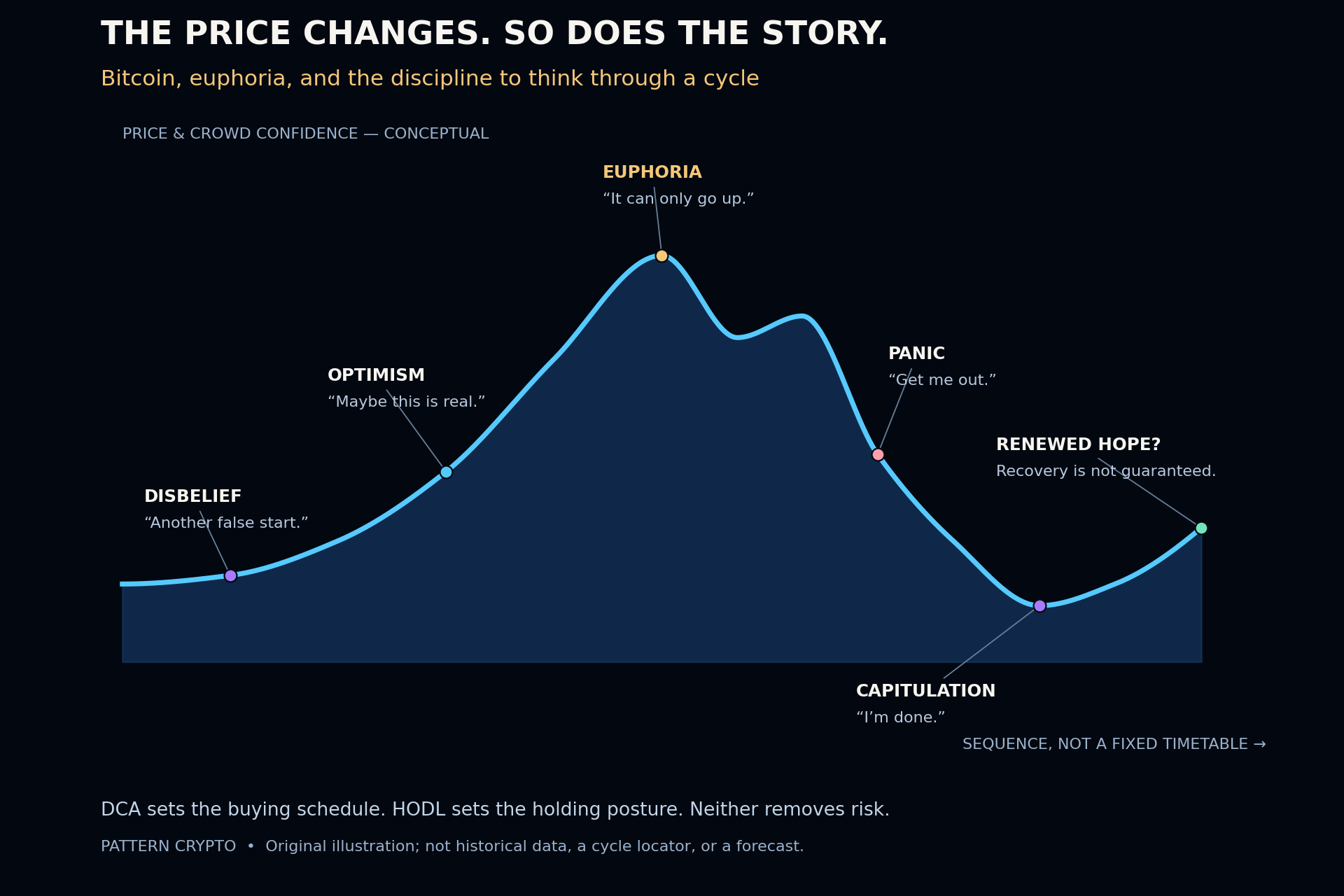
The chart deliberately has no price scale or calendar. These moods can overlap, repeat, or fail to appear in order. The crowd is not one person with one emotional state. A recovery may fail, and a convincing-looking peak may be followed by a further rally.
Bitcoin’s block subsidy halves every 210,000 blocks, approximately every four years. That changes the rate of new issuance. It does not set the amount buyers will pay. Liquidity, borrowing conditions, access, selling pressure, and changing expectations can overwhelm a simple cycle story.
A handful of historical cycles is a small sample, especially when the market’s size and participants have changed. A halving can be relevant without being a clock you can trade with certainty. Knowing the schedule is different from knowing what has already been priced in.
On BitcoinTalk, a user named GameKyuubi published a post titled “I AM HODLING.” Bitcoin was falling, and the author admitted to drinking and being bad at trading. The misspelling survived because the frustration was recognizable: knowing afterward when you should have sold is easier than doing it beforehand.
“It's because I'm a bad trader and I KNOW I'M A BAD TRADER.”
GameKyuubi · BitcoinTalk · December 18, 2013
HODL began as a misspelling of holding, not an acronym. Its original force was an admission of limited market-timing ability. The post did not supply a valuation model or prove that holding any coin indefinitely would succeed.
Original source: BitcoinTalk, “I AM HODLING,” GameKyuubi, December 18, 2013, topic 375643, first post. Checked September 19, 2026.
Holding means keeping an existing position through price fluctuations. Dollar-cost averaging means committing a fixed amount on a regular schedule. You can do either without doing the other. Someone can buy once and hold, or buy regularly while periodically rebalancing.
DCA can reduce the pressure to make one perfectly timed decision. Equal dollar purchases acquire more units at lower prices and fewer at higher prices. But it cannot make a failing asset recover. Spreading an existing cash balance over time can also lag investing it immediately when prices rise. Investing from each paycheck is different from deliberately leaving an available lump sum in cash.
There is a difference between enduring volatility and refusing to reconsider. A useful holding thesis explains why the asset should remain desirable, what risks you accept, and what evidence would change your view. “It has to come back” answers none of those questions.
Bitcoin’s monetary thesis should be assessed on its own merits. Extending its history to every new token is a dangerous shortcut. A thinly traded coin with insider controls can disappear while its holders faithfully repeat the same slogan.
Choose an affordable exposure limit, keep essential reserves separate, and understand custody. Avoid borrowing to sustain a position.
Compare your allocation with the limit you chose. A rally can concentrate your finances without another purchase. Revisit the evidence before increasing your stake.
Separate a price decline from a damaged thesis. Review security, liquidity, and personal cash needs. Neither automatic selling nor automatic buying fits every situation.
Ask whether the original reasons still hold. A changed financial situation or broken assumption can justify a different decision.
You do not need to identify the exact peak to notice that your position has become too large. You do not need to identify the bottom to choose a purchase schedule you can afford. And you do not need to trade every swing to participate in an asset’s long-term outcome.
The most useful lesson in HODL is humility. You can believe an asset has a future while admitting you cannot predict next Tuesday. Pair that belief with manageable exposure, periodic review, and room to change your mind. The goal is to make decisions you can explain after the excitement has passed.
Background sources: Bitcoin whitepaper (2008); Bitcoin.org FAQ, supply and issuance; FINRA, The Benefits and Limitations of Dollar-Cost Averaging (May 19, 2026). Reviewed September 19, 2026. Cycle interpretation and chart are original editorial analysis.
Educational commentary prepared with AI assistance under James Clayton’s editorial direction. The editor holds BTC. This is not individualized financial advice, a cycle-timing signal, or a promise of recovery. Crypto assets can suffer permanent losses.
The strongest cases for long-term relevance.
James Clayton began sharing top-10 crypto lists in 2013. This edition returns to that idea with a tighter selection: five assets, five distinct reasons to pay attention, and clear conditions that could change our minds.
We weigh economic purpose, durability, adoption evidence, and the connection between network success and token demand. The order reflects editorial judgment, not a numerical scoring model. BTC and ETH anchor the list; SOL, LINK, and AAVE add different application and infrastructure theses. All five remain exposed to crypto-wide risks.
Bitcoin earns first place because its central proposition is relatively clear: a monetary asset with verifiable supply rules and no central issuer. It does not need to win every application category. It needs people to keep valuing those monetary properties across changing economic conditions.
Scarcity cannot force buyers to appear. A durable network can still be an expensive investment at the wrong entry price.
A sustained deterioration in security or credible monetary demand would challenge its place. A price decline by itself would not establish either.
Read the full BTC thesis ↗Background: Bitcoin.org — Frequently Asked Questions; Bitcoin whitepaper.
Ethereum earns second place for the breadth of its programmable infrastructure and ETH’s role in fees and staking. The attractive scenario is recurring economic activity that needs shared settlement and security, rather than a succession of temporary speculative applications.
Applications and scaling networks can grow while base-layer economics capture less value than investors expect.
We would reconsider if useful ecosystem activity expanded while ETH became persistently less important to its economics.
Read the full ETH thesis ↗Background: Ethereum.org — Ether; ETH supply mechanics; Ethereum whitepaper.
Solana earns third place for its application-focused opportunity: making blockchain services inexpensive and responsive enough for repeat use. SOL participates through transaction fees and network security. Our conviction depends on lasting demand for those functions, not simply a high activity counter.
Low fees require substantial economic activity, and incentive-driven usage can vanish. Issuance and reliability also matter.
Repeated failures to retain useful activity through quieter markets, or a lasting breakdown in reliability, would weaken its claim.
Read the full SOL thesis ↗Background: Solana — Transaction fees; staking and inflation documentation.
Chainlink earns fourth place because external data and connectivity can be useful across many applications and chains. Supported fee conversion into LINK provides a specific economic mechanism to examine alongside its infrastructure role. We prefer a thesis tied to paying customers over one based solely on integration announcements.
Not every partnership generates substantial revenue, and not every dollar of associated activity becomes LINK demand.
We would reconsider if recurring paid usage and meaningful token demand consistently failed to follow the adoption narrative.
Read the full LINK thesis ↗Background: Chainlink — Economics; Payment Abstraction; Chainlink Reserve.
Aave earns fifth place because lending and borrowing solve an identifiable financial need. The protocol lets suppliers provide liquidity and borrowers obtain loans against collateral. This offers a different thesis from adding another general-purpose blockchain to the list.
Aave’s token documentation describes revenue-funded purchases of AAVE for the DAO’s ecosystem reserve. That gives token economics a concrete mechanism to assess, but the program is governed, can change, and does not guarantee a dividend or price appreciation. Tokens acquired for a reserve are not the same as tokens permanently burned.
Smart-contract failures, collateral shocks, bad debt, and governance decisions can undermine the protocol. AAVE is a governance token, not an ownership share in borrowers’ interest payments.
A serious deterioration in risk management, durable lending demand, or the economic case for holding AAVE would put its place under review.
Review our fundamentals framework ↗Background: Aave documentation — Protocol Overview; AAVE Token. Reviewed September 19, 2026.
Source: Aave documentation — AAVE Token. These mechanisms do not entitle holders to a dividend.
This is the September 19, 2026 edition, not a live ranking. Future revisions should explain additions, removals, and changes in order. An asset can remain interesting while falling off the list, and a good thesis can become an unattractive purchase at an excessive valuation.
Prepared with AI assistance under James Clayton’s editorial direction. The editor holds some assets discussed, which can create bias. Educational commentary, not individualized financial advice. Substantial or total losses are possible. Project documentation supports the mechanisms described; the rankings and removal criteria are Pattern Crypto analysis.
September 19, 2026 — First edition: BTC, ETH, SOL, LINK, AAVE. No ranking changes have been made. Future editions will record changes and their reasons here.
Hundreds of obituaries later, the critics have not disappeared. But there is a better argument to have than whether the next price crash is the funeral.
Archive snapshot checked September 18, 2026. A curated count—not a complete census of every prediction.
Bitcoin has an unusual relationship with death. Most things experience it once. Bitcoin gets pronounced dead, trades through the weekend, and comes back to inconvenience the person who wrote the obituary. At some point, you might expect the funeral industry to ask for payment in advance.

BitcoinDeaths reported 478 obituary entries when checked for this article, including 24 in 2026. Its archive identifies 2017 as the busiest year, with 93. That is enough to answer the basic question: predictions of Bitcoin’s demise are still being collected. It is not enough to establish that every critic is repeating the same argument, or that criticism is steadily disappearing.
The count belongs to that archive. “Dead” is an editorial category: someone must decide whether a remark qualifies, which speakers count, and whether separate appearances represent separate predictions. Different archives need not agree. The useful finding is the persistence of the genre, not a supposedly official number of times humanity has been wrong. Source: BitcoinDeaths obituary archive and methodology, checked September 18, 2026.
Three different propositions often get bundled into one dramatic headline: the price could fall, the asset could be a poor investment at today’s valuation, and the network could stop having a meaningful future. They are not interchangeable. A functioning network can support an overpriced asset. A severe price decline can hurt holders without ending the network. And a critic can be right about a risk while being spectacularly early—or wrong—about the final outcome.
That distinction matters to supporters too. Counting failed obituaries is entertaining. Using the count as a valuation model is considerably less useful. Survival answers the question of whether Bitcoin has survived so far. It does not tell a new buyer what return to expect from the price on the screen.
There is a concrete example of how the discussion can become more complicated than believers versus skeptics. On January 10, 2024, the SEC approved the listing and trading of spot Bitcoin exchange-traded product shares. In the same statement, Chair Gary Gensler emphasized that the decision did not endorse Bitcoin and retained strong warnings about its risks. Access expanded without the regulator becoming a cheerleader. Source: SEC, Statement on the Approval of Spot Bitcoin Exchange-Traded Products, January 10, 2024.
Our interpretation is that this is a more revealing tension than another obituary. A financial system can accommodate an asset without settling the argument about its value. A skeptical investor can accept that Bitcoin is likely to remain tradable while still refusing to own it. Neither position requires a prediction that the network disappears next Tuesday.
Is there durable demand for a monetary asset without a central issuer? How much of that demand is already reflected in price? What would weaken it? Those questions require more effort than declaring victory after a rally or writing an obituary after a sell-off. They also remain useful whichever direction the next candle goes.
So no, the obituary writers have not all retired. But Bitcoin’s supporters do not need to turn that into a claim of immortality. The sharper case is that repeated survival deserves to be considered, while valuation, custody, security, and demand still deserve scrutiny. Bitcoin has made an awkward subject for obituary writers. That does not make it an effortless subject for investors.
Original Pattern Crypto commentary, prepared with AI assistance. Archive figures are a dated snapshot, not a live counter. The broader interpretation is editorial analysis.
Bitcoin does not need to replace every bank or currency. The optimistic case is that more people come to value a monetary asset no single issuer controls.
“What is needed is an electronic payment system based on cryptographic proof instead of trust”
Satoshi Nakamoto
Bitcoin: A Peer-to-Peer Electronic Cash System, introduction (2008); excerpt. Verified September 19, 2026.
The excitement begins with a change in who must be trusted. Satoshi proposed a way for participants to transact without relying on a central payment intermediary. Our bullish interpretation is that this independence can be valuable alongside verifiable scarcity: people may want to hold an asset whose rules and transfers are checked by a network rather than controlled by one issuer. The quote explains the original purpose; the investment case still depends on people continuing to value it.
How to read it: These establish monetary design, not a floor under the market price.
Source: Bitcoin.org — FAQ. Checked September 19, 2026. Documentation facts, not a live adoption dashboard.
Bitcoin asks a monetary question before it asks a technological one: what would people pay to hold an asset whose issuance is governed by verifiable rules rather than a central issuer? Its 21-million supply limit gives that question a clear starting point. The investment case begins when someone finds those properties worth owning through an uncomfortable market—not merely worth discussing during a rally.
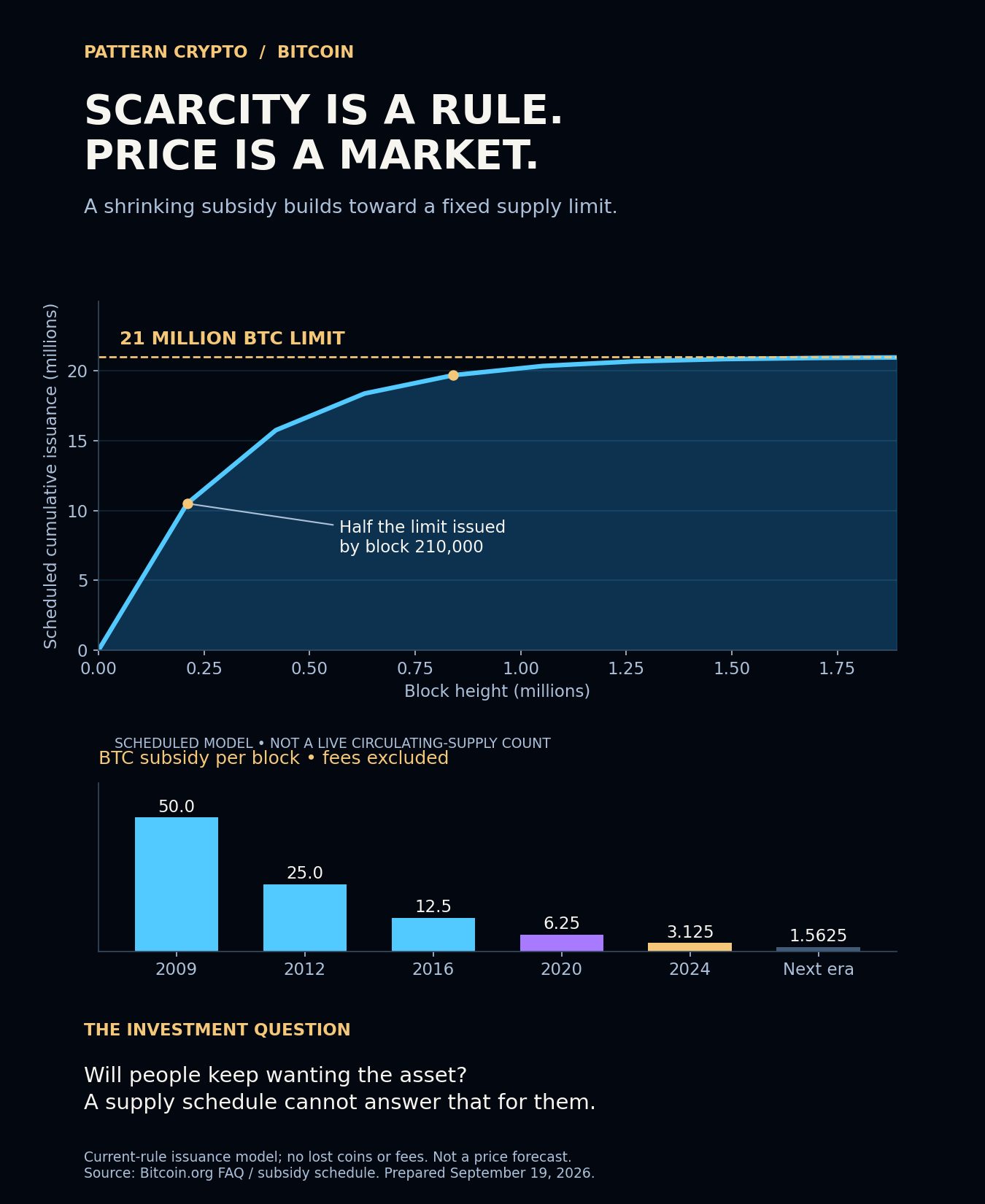
Scheduled cumulative issuance: 10.5 million BTC at block 210,000, 15.75 million at 420,000, 18.375 million at 630,000 and 19.6875 million at 840,000. Subsidies by era: 50, 25, 12.5, 6.25, 3.125, then 1.5625 BTC per block. Fees and lost coins excluded. Demand determines what buyers will pay.
The positive scenario is expanding monetary demand. Bitcoin need not become everyone’s everyday payment method to have a larger role in savings, settlement, or portfolio allocation. If a broader pool of buyers wants to hold it over time, a supply that cannot expand freely in response could support higher prices. That is a conditional argument about demand meeting constrained supply—not a forecast that every halving causes a rally.
Background sources: Bitcoin.org — Frequently Asked Questions: supply, monetary properties, mining, and risks. Reviewed September 18, 2026. The investment interpretation is Pattern Crypto analysis.
Imagine two futures with exactly the same supply rules. In one, more people want a portable asset outside a central issuer’s control. In the other, that preference fades. Bitcoin is equally scarce in both futures, but the investment outcomes can be very different. A fixed supply constrains the response to demand; it does not create demand.
The useful distinction is between temporary buying and a lasting reason to hold. A buyer chasing this month’s momentum can disappear quickly. Someone using BTC as a long-term monetary allocation may behave differently, although neither group is immune to panic. Our strongest version of the thesis is growing monetary relevance through several market environments—not a mechanical prediction based on the next supply milestone.
We would become less optimistic if broader access and recognition repeatedly failed to produce durable holding demand. A rising price alone would not resolve that concern.
Analytical illustration, not reported project activity or a price forecast.
Bitcoin could remain a durable, widely traded monetary asset while delivering modest or uneven returns. Existing expectations may already reflect substantial future adoption. A network that succeeds and an investor who pays too much can coexist; neither a supply cap nor longevity establishes fair value.
Demand could stagnate or migrate elsewhere, while restrictive access, custody failures, leverage, or security concerns undermine confidence. BTC provides no operating-company earnings or dividend to anchor a valuation. Scarcity alone cannot prevent deep losses when buyers retreat.
Educational fundamentals analysis, prepared with AI assistance. Not individualized financial advice. These scenarios are not probability estimates, guarantees, or claims that the asset is attractively priced today. Review your own circumstances and risk tolerance before investing.
The optimistic Ethereum thesis is about useful economic activity: more assets, payments, and agreements settling on programmable infrastructure—and a meaningful role for ETH within it.
“Building tools, not empires.”
Vitalik Buterin
Vitalik Buterin — Make Ethereum Cypherpunk Again, December 28, 2023; excerpt. Verified September 19, 2026.
Buterin’s argument is about open participation, interoperability, and tools users can choose freely. That gives Ethereum a more ambitious purpose than another trading venue: shared infrastructure that others can build on without asking one company for permission. Our investment interpretation is narrower. That openness can help attract useful activity, but ETH still needs to retain an important economic role within it.
How to read it: These are functional uses. They do not measure how much demand future applications will create.
Source: Ethereum.org — What is Ether?. Checked September 19, 2026. Documentation facts, not a live adoption dashboard.
A borrower, a stablecoin transfer, and a tokenized asset can look like separate businesses while relying on shared financial infrastructure. Ethereum’s opportunity sits underneath those activities. ETH pays network fees and helps secure the system through staking, connecting the asset to the platform. The hard part is judging how much economic value reaches ETH as applications become cheaper and more widely used.
ETH’s supply mechanics add another dimension: base fees are burned while validators receive issuance. Net supply can rise or fall depending on that balance. Our positive interpretation is that useful activity and credible security could reinforce ETH’s economic role over time. The important condition is that ecosystem growth also benefits the asset; transaction growth on its own is insufficient.
Background sources: Ethereum.org — What is ether (ETH)?; How The Merge impacted ETH supply. Reviewed September 18, 2026. The investment interpretation is Pattern Crypto analysis.
Consider an application that attracts many users while making each transaction dramatically cheaper. That is a product success. Whether it benefits ETH depends on what the application ultimately pays for Ethereum settlement and security, and how that demand interacts with issuance and fee burning. User growth and token value capture are separate questions.
This is why “more activity” is an incomplete Ethereum thesis. The stronger argument identifies a service people need, a reason it benefits from Ethereum’s security, and an economic link that survives competition and falling unit costs. Scaling is attractive because it can broaden access; it also makes the path from ecosystem growth to base-layer economics more important to examine.
We would downgrade the thesis if the ecosystem expanded for an extended period while ETH’s economic role became less important. Strong applications would not, by themselves, settle that objection.
Analytical illustration, not reported project activity or a price forecast.
Ethereum’s ecosystem could expand while ETH returns remain restrained. Scaling can make applications cheaper and more usable without producing a proportional increase in base-layer fees. The network might succeed as infrastructure while its token captures less value than optimistic investors expect.
Competing networks could attract users and developers. Low fee demand could limit burning, while issuance continues. Security failures, staking concentration, or complex application dependencies could weaken confidence. Staking rewards do not cancel the risk of a falling ETH price or a flawed investment thesis.
Educational fundamentals analysis, prepared with AI assistance. Not individualized financial advice. These scenarios are not probability estimates, guarantees, or claims that the asset is attractively priced today. Review your own circumstances and risk tolerance before investing.
The positive Solana thesis is that useful applications can turn occasional visitors into returning users—and make the network’s native asset economically relevant beyond the trading cycle.
“PoH is used to encode trustless passage of time into a ledger”
Anatoly Yakovenko
Solana: A New Architecture for a High Performance Blockchain, whitepaper v0.8.13, abstract; excerpt. Verified September 19, 2026.
Yakovenko’s technical ambition was to improve how a distributed network coordinates the order of events. The appealing application-level possibility is less waiting and less friction: services people choose for what they do, without needing to think about the blockchain underneath. That is our interpretation of the opportunity, not a quoted promise of adoption or investment returns. Proof of History is part of the design, not a substitute for the wider consensus system; useful products and sustainable SOL demand still have to follow.
How to read it: Fee composition matters. More fees do not all produce the same amount of token burning.
Source: Solana documentation — Fees. Checked September 19, 2026. Documentation facts, not a live adoption dashboard.
A payment app does not get a second chance to feel effortless. Neither does a trading screen that leaves a user waiting. Solana’s opportunity starts with that ordinary expectation: services should be responsive and inexpensive enough that people return for the task itself. The bull case is a growing population of useful applications—not a requirement that every user become a blockchain enthusiast.

SOL has a functional place in that scenario. Transactions require fees paid in SOL, and holders can delegate stake to validators to help secure the network. If useful activity becomes more durable, demand for those functions could become more durable too. The bullish argument is strongest when the network supports repeated economic use, rather than briefly attracting capital with incentives.
Low fees are attractive to users, but SOL’s economics depend on aggregate demand. The useful comparison is sustained fee demand against ongoing issuance, with attention to whether activity survives the withdrawal of incentives.
Background sources: Solana documentation — Transaction fees; Solana — Staking overview and inflation schedule. Reviewed September 18, 2026. The investment interpretation is Pattern Crypto analysis.
Imagine two applications with identical transaction counts. One pays people to show up briefly. The other helps customers complete a task they would pay to repeat. The headline activity looks similar, but the second offers stronger evidence of lasting demand. Automated transactions can be useful too; the question is what economic purpose they serve.
For SOL, inexpensive transactions are both an advantage and an investment challenge. Low friction can attract more uses, but each use may require only a small amount of the token. The thesis needs enough sustained economic activity to make fees and security demand meaningful alongside issuance. A busy network is the beginning of the investigation, not the conclusion.
We would become less optimistic if users repeatedly disappeared after rewards or speculative excitement faded. Retention through quieter periods would be more persuasive than another peak activity record.
Analytical illustration, not reported project activity or a price forecast.
Solana could build a useful application economy without producing exceptional SOL returns. Fees may remain small, some activity may be automated, and additional supply may offset part of the benefit. Success for applications and success for token holders need not arrive at the same pace.
Users could leave when incentives fade, or competing platforms could offer a more attractive experience. Reliability, validator economics, and security remain central to the thesis. Ongoing inflation can dilute non-staking holders, while staking rewards are not a guarantee of a positive return in dollars.
Educational fundamentals analysis, prepared with AI assistance. Not individualized financial advice. These scenarios are not probability estimates, guarantees, or claims that the asset is attractively priced today. Review your own circumstances and risk tolerance before investing.
A research-led network has a compelling opportunity—if careful engineering becomes useful everyday activity.
How to read it: Delegation establishes a security role; rewards are not evidence of customer adoption or dollar profits.
Source: Cardano.org — What is ada?. Checked September 19, 2026. Documentation facts, not a live adoption dashboard.
A carefully drawn bridge is valuable when people can cross it. Cardano’s research-led approach has the same test: turning engineering into applications people choose to use. ADA’s fee and delegation roles give that activity an economic connection to the asset.

The opportunity is not simply that the technology was built carefully. It is that reliable infrastructure, an engaged community, and a long development horizon could give builders room to create useful financial and digital services. A platform does not need to win every category to matter. It does need enough demand to sustain its economic role.
Background sources: Cardano.org — What is ada?; Cardano staking and delegation resources. Reviewed September 18, 2026. Investment interpretations are Pattern Crypto analysis.
A useful way to test Cardano is to imagine a customer who has never heard of its research philosophy. Would that customer choose an application built on it because the product solves a problem? The investment case becomes stronger when the answer survives without an explanation of the chain’s design pedigree.
Engineering quality can matter enormously, but it is an input. Adoption is an outcome. Between them sit developer tools, distribution, liquidity, and the everyday experience of using applications. ADA’s role in fees and security provides the connection to the network; the question is whether demand for those functions grows enough to justify what investors pay.
A long sequence of technical achievements without corresponding repeat use would weaken our optimism. We would give more weight to durable applications than to roadmap completion alone.
Analytical illustration, not reported project activity or a price forecast.
Cardano could remain a resilient ecosystem with a committed community while growing gradually. ADA might track broader crypto conditions more closely than application progress. A functioning network and staking rewards do not establish that the entry price is attractive.
Competing platforms could capture developers and liquidity faster. Slow adoption would weaken demand despite sound engineering. Rewards paid in ADA can be outweighed by price declines, and a loyal community cannot substitute indefinitely for useful economic activity.
Educational analysis developed with AI assistance. The editor holds or has expressed interest in assets covered; holdings can create bias and may change. Not personal financial advice. Substantial or total losses are possible.
The strongest infrastructure often works out of sight. Can reliable data and connectivity translate into durable LINK demand?
How to read it: The mechanism connects supported payments to the token, but its size and durability still matter.
Source: Chainlink — Economics. Checked September 19, 2026. Documentation facts, not a live adoption dashboard.
A smart contract cannot inspect a shipment or observe the weather on its own. Chainlink connects applications to outside information and other systems. That gives it an opportunity across networks, rather than a bet on one chain winning everything.

LINK’s economics are central to that argument. Chainlink describes payment abstraction that converts supported service revenue into LINK, alongside its strategic reserve initiative. Staking also gives the token a security-related function. Those mechanisms deserve attention because useful software alone does not automatically create an attractive token investment.
Background sources: Chainlink — Economics; Payment Abstraction and SVR Fee Conversion; Chainlink Reserve. Reviewed September 18, 2026. Investment interpretations are Pattern Crypto analysis.
Picture a financial application that integrates a data service but remains in testing. Now compare it with an application that continuously pays for the service because its operations depend on it. Both can appear in an integration announcement. Only the second demonstrates recurring commercial demand.
For LINK, the next step is equally important: which payments are connected to token demand, through which mechanism, and at what scale? Supported fee conversion and reserve activity make that question more concrete. They do not turn LINK into equity or entitle holders to all the revenue associated with Chainlink. Our interest is in necessary infrastructure becoming a repeat business with observable token economics.
We would become more cautious if integration announcements kept multiplying while evidence of recurring paid usage and meaningful fee conversion remained limited.
Analytical illustration, not reported project activity or a price forecast.
Chainlink could become more widely integrated while LINK’s valuation already reflects much of that success. Service adoption may develop faster than token demand. Announcements and experiments can be useful steps without immediately becoming substantial recurring business.
Competition, security failures, or customers choosing alternative architectures could reduce demand. Token economics may capture less value than expected. LINK is not company equity, and neither reserve purchases nor staking guarantees a dividend or positive dollar return.
Educational analysis developed with AI assistance. The editor holds or has expressed interest in assets covered; holdings can create bias and may change. Not personal financial advice. Substantial or total losses are possible.
Predictable network costs could attract practical use. The harder question is how much value reaches HBAR.
How to read it: The same dollar fee requires fewer HBAR when the token price rises. Transaction counts alone miss this distinction.
Source: Hedera documentation — Fees. Checked September 19, 2026. Documentation facts, not a live adoption dashboard.
A business wants to know what its next million operations will cost. Hedera’s fees are denominated in dollars and paid in HBAR at the applicable conversion rate, making that budget easier to plan. The opportunity is turning useful trials into recurring operations.

But the mechanics matter. Because fees are priced in dollars, a higher HBAR price means fewer tokens are needed for the same dollar fee. Cheap transactions also require substantial aggregate activity to generate significant fees. The bull case therefore rests on economically meaningful adoption and sustainable demand, not simply an impressive number on a transaction dashboard.
Background sources: Hedera documentation — Network fees and fee denomination. Reviewed September 18, 2026. Investment interpretations are Pattern Crypto analysis.
Suppose a network processes ten times as many transactions, but the average economic value collected per transaction falls sharply. The activity chart can look spectacular while the fee picture improves much less. For HBAR, dollar-denominated fees add another distinction: a higher token price reduces the tokens needed to pay an unchanged dollar charge.
That does not invalidate the thesis. It changes what evidence matters. We would look for applications whose customers keep paying because the service is useful, then examine the aggregate economics. Council participation, a recognizable customer, or a large transaction counter can offer context; none tells us automatically how much demand reaches HBAR.
If usage depended persistently on subsidies or generated little recurring economic demand, we would lower our confidence even if the transaction count continued climbing.
Analytical illustration, not reported project activity or a price forecast.
Hedera could support useful business applications while token returns remain modest. Low costs benefit users, but may limit the direct demand created by each transaction. Network relevance and investment performance could develop at different speeds.
Projects may remain subsidized trials or fail to reach commercial scale. Competition and governance concerns could discourage adoption. Holding HBAR gives no ownership interest in council members or automatic claim on the businesses using the network.
Educational analysis developed with AI assistance. The editor holds or has expressed interest in assets covered; holdings can create bias and may change. Not personal financial advice. Substantial or total losses are possible.
The opportunity is a useful application economy. The test is whether users stay after the incentives stop.
How to read it: A maximum supply is not the current circulating supply. Releases can matter even under a cap.
Source: Sui — Token Supply and Circulation. Checked September 19, 2026. Documentation facts, not a live adoption dashboard.
People rarely choose a game because of its database. Sui’s strongest opportunity is similarly practical: applications that feel useful and responsive enough for people to return without thinking about the chain underneath.

SUI pays for gas and participates in network security through staking. These functions give the token a connection to the platform’s operation. The bullish scenario is that growing, repeated use makes those functions more economically significant over time, supported by developers who continue shipping after an initial launch.
Watch circulating supply as closely as application launches. A total supply cap does not stop scheduled releases from increasing the tokens available to sell. Adoption has to be assessed alongside that changing supply.
Background sources: Sui — SUI Token Schedule and token utility. Reviewed September 18, 2026. Investment interpretations are Pattern Crypto analysis.
Imagine a game launching with rewards that attract a large initial audience. The more revealing moment comes later: rewards are smaller, competing games are available, and users must decide whether the experience is worth their time. Retention at that point says more about product demand than opening-week account creation.
SUI adds a supply-side question to that product test. Growing interest can coexist with growing circulating supply. A fixed maximum supply is not a reason to ignore tokens becoming available along the way. Our constructive case needs useful applications to develop fast enough that demand for the network and its token can absorb those changes.
We would become more cautious if successive launches produced brief bursts followed by empty applications, especially while circulating supply continued expanding.
Analytical illustration, not reported project activity or a price forecast.
Sui could establish a productive niche while SUI delivers uneven returns. Applications may grow from a small base, and additional circulating supply may absorb some new demand. Early activity can be encouraging without proving durable competitive advantage.
Users and developers could move to competing platforms, particularly when incentives disappear. Security problems or weak token demand could undermine confidence. Unlocks can create selling pressure even when the network itself continues to improve.
Educational analysis developed with AI assistance. The editor holds or has expressed interest in assets covered; holdings can create bias and may change. Not personal financial advice. Substantial or total losses are possible.
Real-world assets are a powerful theme. Owning ONDO is a distinct proposition that needs its own evidence.
How to read it: No planned inflation does not mean no unlocks. Governance is different from a right to Treasury-product income.
Source: Ondo Foundation — The ONDO Token. Checked September 19, 2026. Documentation facts, not a live adoption dashboard.
A Treasury product and a governance token can share a brand while giving their holders different rights. Start there with Ondo. ONDO concerns governance associated with the Ondo DAO and Flux Finance; owning it is not the same as owning the underlying tokenized Treasury products.

The optimistic scenario is that a growing ecosystem makes governance decisions more consequential. If participants increasingly value the ability to influence supported protocols, governance rights could become more desirable. That is a conditional source of demand, not a promise that product growth automatically distributes income to holders.
Background sources: Ondo Foundation documentation — ONDO Token. Reviewed September 18, 2026. Investment interpretations are Pattern Crypto analysis.
Imagine a tokenized financial product attracting customers because it offers convenient access to an asset. Those customers may want the product’s exposure or income. That does not mean they want a governance token, and it does not mean the governance token receives the product’s earnings.
This distinction makes ONDO one of the more demanding theses in the series. Governance can be valuable when decisions genuinely matter and participation is desirable. But “tokenization is growing” leaves the key investment question unanswered: why should someone need to acquire and retain ONDO? A serious answer has to describe its actual rights and incentives, not borrow the economics of a different product.
If product adoption grew but governance remained economically peripheral, we would treat that as a weakness in the token thesis rather than a reason to repeat the broader tokenization story.
Analytical illustration, not reported project activity or a price forecast.
Tokenization could expand substantially while ONDO performs only moderately. Products can succeed without giving governance holders a direct claim on their yield. The ecosystem’s progress may be real even if token value capture remains limited.
Governance rights may attract little sustained demand or remain concentrated. Additional circulating supply could pressure price. ONDO does not itself give holders ownership of Treasury reserves, company equity, or an automatic entitlement to product income.
Educational analysis developed with AI assistance. The editor holds or has expressed interest in assets covered; holdings can create bias and may change. Not personal financial advice. Substantial or total losses are possible.
Useful payment rails can create lasting relevance. XLM still needs an economic case of its own.
How to read it: These create native-token uses without implying that payment volume becomes an equivalent amount of long-term holdings.
Source: Stellar documentation — Lumens. Checked September 19, 2026. Documentation facts, not a live adoption dashboard.
A payment succeeds when value reaches the person who needs it. Stellar’s case begins with making payment and asset-transfer systems easier to connect, especially where moving money across systems creates friction.

XLM has native network functions: transaction fees and minimum account balances require it, with additional resource costs for smart-contract activity. Those requirements connect the asset to usage. If a larger ecosystem develops, more participants could need XLM to interact with it, creating a recurring base of functional demand.
Background sources: Stellar developer documentation — Lumens. Reviewed September 18, 2026. Investment interpretations are Pattern Crypto analysis.
Consider someone sending a stable-value asset across a network. The sender may value speed and convenience while wanting almost no exposure to the native token. A service provider can handle the required network resources in the background. The payment is useful even if the sender never becomes a meaningful XLM investor.
That is why our Stellar thesis distinguishes adoption of the rails from demand for the asset. Fees, account balances, and resource requirements connect XLM to the network. The scale and persistence of those requirements determine how much of the payment story matters to holders. Cheap access is an advantage for customers, but it also raises the amount of activity needed to create substantial token demand.
We would question the investment case if payment adoption advanced without materially strengthening demand for XLM’s native functions.
Analytical illustration, not reported project activity or a price forecast.
Stellar could become useful infrastructure for particular payment corridors while XLM returns stay restrained. Low transaction costs are good for customers but may produce limited token demand. Payments growth and token appreciation need not move together.
Competing payment rails could win distribution or offer simpler experiences. High transaction volume might require little XLM inventory, weakening value capture. XLM holders do not own the reserves backing assets issued by other organizations on Stellar.
Educational analysis developed with AI assistance. The editor holds or has expressed interest in assets covered; holdings can create bias and may change. Not personal financial advice. Substantial or total losses are possible.
Fast movement of value is useful. The investment question is whether that usefulness requires sustained XRP demand.
How to read it: Original supply and circulating availability differ. Neither establishes how much XRP payment users will retain.
Source: XRP Ledger documentation — XRP Overview. Checked September 19, 2026. Documentation facts, not a live adoption dashboard.
Money can sit idle because two markets need separate pools of liquidity. XRP’s bridge-asset thesis asks whether an accessible intermediary can connect those markets more efficiently. The answer depends on depth, execution cost and actual use—not ledger speed alone.

A successful bridge needs more than a fast ledger. Participants must be able to acquire and sell meaningful amounts at acceptable costs, and they need reasons to choose it over other settlement options. The bullish scenario is a reinforcing cycle in which better liquidity supports useful activity and repeated activity encourages deeper liquidity.
Background sources: XRP Ledger documentation — About XRP. Reviewed September 18, 2026. Investment interpretations are Pattern Crypto analysis.
Think of a bridge asset acquired, transferred, and sold within a short interval. The same pool of capital can support repeated transfers. That efficiency is attractive to users, but it means a large payment-volume figure cannot simply be translated into an equally large requirement to hold XRP.
The stronger question is how much reliable liquidity participants need to maintain, across which markets, and why XRP is their preferred route. Spreads, execution costs, and availability matter alongside settlement speed. We would also distinguish a business announcement involving Ripple from an implementation that demonstrably requires XRP; one does not automatically establish the other.
Our confidence would weaken if headline partnerships expanded while XRP-dependent usage and persistent liquidity demand remained unclear.
Analytical illustration, not reported project activity or a price forecast.
The ledger could remain active and XRP liquid while adoption produces less price impact than expected. Efficient turnover can support payments with relatively small inventories. Existing expectations may already price in significant future expansion.
Alternative settlement assets could prove more convenient or less volatile. Liquidity may concentrate in speculative trading rather than practical transfers. Escrow-related supply releases matter, and owning XRP gives no ownership stake in Ripple or claim on its earnings.
Educational analysis developed with AI assistance. The editor holds or has expressed interest in assets covered; holdings can create bias and may change. Not personal financial advice. Substantial or total losses are possible.
An information-rich world needs provenance. Can a decentralized knowledge graph turn that need into paid demand?
How to read it: There is an identifiable service mechanism. The documentation alone does not establish the scale of repeat paid demand.
Source: OriginTrail — TRAC Token. Checked September 19, 2026. Documentation facts, not a live adoption dashboard.
An AI answer is easier to question when you can follow its evidence. OriginTrail’s decentralized knowledge graph addresses how information is organized, discovered and connected to verifiable records. Its opportunity is making those connections useful enough for organizations to pay for them.

TRAC has a defined role in that network. Publishers compensate node operators for making knowledge assets available, while collateral and staking mechanisms help coordinate participation. That gives the thesis a concrete question: will people and organizations repeatedly pay for the service because it solves a problem worth paying to solve?
Background sources: OriginTrail — TRAC Token and Decentralized Knowledge Graph resources. Reviewed September 18, 2026. Investment interpretations are Pattern Crypto analysis.
Imagine a supplier publishing a record with a verifiable origin and history. That can help another organization examine where the record came from and whether it changed. It cannot, by itself, establish that the supplier’s original statement was accurate. An evidence trail improves accountability without eliminating the need to judge the evidence.
This gives OriginTrail a more specific opportunity than the broad claim that AI needs better data. Organizations must find enough value in publishing, organizing, and retrieving knowledge assets to pay repeatedly. TRAC’s network role is then relevant to a service with a customer, rather than just a narrative with an audience.
We would lower our confidence if the project attracted attention for AI branding but failed to demonstrate continuing demand for paid knowledge publication and availability.
Analytical illustration, not reported project activity or a price forecast.
OriginTrail could serve valuable specialized uses while adoption remains relatively narrow. The technology may help particular organizations without becoming universal AI infrastructure. Token returns could lag useful progress if current expectations already assume a much larger market.
Customers could prefer conventional databases or alternative verification systems. Paid demand may fail to match the AI narrative. Implementation complexity, concentrated customers, and token volatility could impede adoption; a verifiable record does not independently establish factual truth.
Educational analysis developed with AI assistance. The editor holds or has expressed interest in assets covered; holdings can create bias and may change. Not personal financial advice. Substantial or total losses are possible.
A straightforward payments asset can have a role without becoming the center of every new crypto narrative.
How to read it: These describe a use case and feature, not an independently measured market share or guaranteed investment return.
Source: Litecoin Foundation — Litecoin.com overview. Checked September 19, 2026. Documentation facts, not a live adoption dashboard.
Sometimes the job is simply to send value from one person to another. Litecoin’s case rests on doing that job reliably, with enough accessibility and liquidity to remain useful as newer narratives compete for attention.

Simplicity can be an advantage when the task is also simple. Users who want to send a digital asset may care more about availability, transaction cost, and a familiar experience than a fashionable roadmap. If Litecoin remains useful across market cycles, that continued relevance could support monetary demand even as attention moves elsewhere.
Background sources: Litecoin — Official website and payments overview. Reviewed September 18, 2026. Investment interpretations are Pattern Crypto analysis.
Consider a user who buys LTC to transfer value and a recipient who immediately sells it. Both may be satisfied with the payment experience. Neither necessarily creates sustained demand to hold the asset. Payment usefulness and monetary investment demand overlap, but they are not interchangeable.
The stronger Litecoin case asks why some participants would maintain balances, keep liquidity available, or choose it repeatedly over alternatives. Familiarity and a straightforward purpose can help. They still need to support enough demand relative to valuation. A long history earns a closer look; it does not establish that future returns must compensate an investor for the risk.
We would become less optimistic if practical use narrowed and persistent holding demand weakened, even if the network continued operating as designed.
Analytical illustration, not reported project activity or a price forecast.
Litecoin could retain a recognizable niche while delivering average or inconsistent performance. Reliability and availability can keep a network useful without creating rapid demand growth. A payment tool may work well even when its investment narrative is quiet.
Stablecoins and other payment rails could offer users a more attractive experience. Monetary demand may consolidate around competing assets. If users hold LTC only briefly for transfers, payment activity may provide less lasting price support than bulls expect.
Educational analysis developed with AI assistance. The editor holds or has expressed interest in assets covered; holdings can create bias and may change. Not personal financial advice. Substantial or total losses are possible.
The Artificial Superintelligence Alliance brings an ambitious vision. The investment case still needs real customers.
How to read it: Current functions and roadmap items must be distinguished. The AI opportunity is larger than proven token demand.
Source: ASI Alliance — ASI Token (FET). Checked September 19, 2026. Documentation facts, not a live adoption dashboard.
An independent AI developer needs more than a model: customers, services and a way to coordinate with other tools. The Artificial Superintelligence Alliance’s FET thesis is a marketplace that helps connect those pieces, with a meaningful role for its ecosystem token.

The optimistic thesis is that useful AI services attract repeat demand and that token-based access, payments, and network security retain a meaningful role. An ecosystem that helps independent builders reach customers could become valuable even without winning the race to the largest frontier model. The opportunity is coordination and access, not merely attaching an AI label to an asset.
Background sources: Artificial Superintelligence Alliance — ASI Token (FET), ecosystem utility and staking overview. Reviewed September 18, 2026. Investment interpretations are Pattern Crypto analysis.
Dr. Ben Goertzel remains involved: SingularityNET’s official team page lists its founder as CEO and Chief Scientist, and identifies SingularityNET as a founding member of the ASI Alliance. His background in artificial general intelligence and cognitive architectures gives this project a research story that extends beyond the token. The team also has a robotics connection through co-founder Dr. David Hanson, the roboticist behind Sophia.
For the optimistic thesis, that experience is a reason to follow the work closely. It still needs to translate into useful products, adoption, and sustainable token demand.
Leadership source: SingularityNET — About Us, executive and founding team listings. Checked September 19, 2026.
Imagine an AI service that attracts paying customers but accepts conventional payments and needs little token exposure. That may be a successful product. An investor still needs to understand whether its activity creates meaningful FET demand, and whether that demand persists after the initial transaction.
Our strongest ASI thesis is a marketplace where independent builders gain access to customers and useful infrastructure, with FET serving a necessary economic role. The relevant evidence is paid repeat use, working integrations, and clearly implemented token functions. A research pedigree makes the project worth following, but neither prominent researchers nor an ambitious name can substitute for that connection.
We would become more cautious if product announcements consistently outpaced repeat customer use, or if the ecosystem grew while the token became less necessary to its operation.
Analytical illustration, not reported project activity or a price forecast.
The ecosystem could deliver useful services while token demand grows slowly. Some users may prefer conventional payment methods or competing platforms. The network could become useful infrastructure without capturing enough economic value to justify optimistic token valuations.
Execution could fall behind ambitious plans, or centralized and open-source alternatives could meet users’ needs more effectively. Token utility may be weaker than expected. Competition, uncertain value capture, and token volatility could leave investors with poor returns even as the wider AI industry expands.
Educational analysis developed with AI assistance. The editor holds or has expressed interest in assets covered; holdings can create bias and may change. Not personal financial advice. Substantial or total losses are possible.
A regular buying plan can make volatile markets easier to navigate. Asset quality and position size still come first.
Dollar-cost averaging means investing a fixed dollar amount at regular intervals. You buy more units when prices are lower and fewer when they are higher. Its practical appeal is behavioral: a decision made calmly in advance can replace the pressure to guess the perfect entry every week.
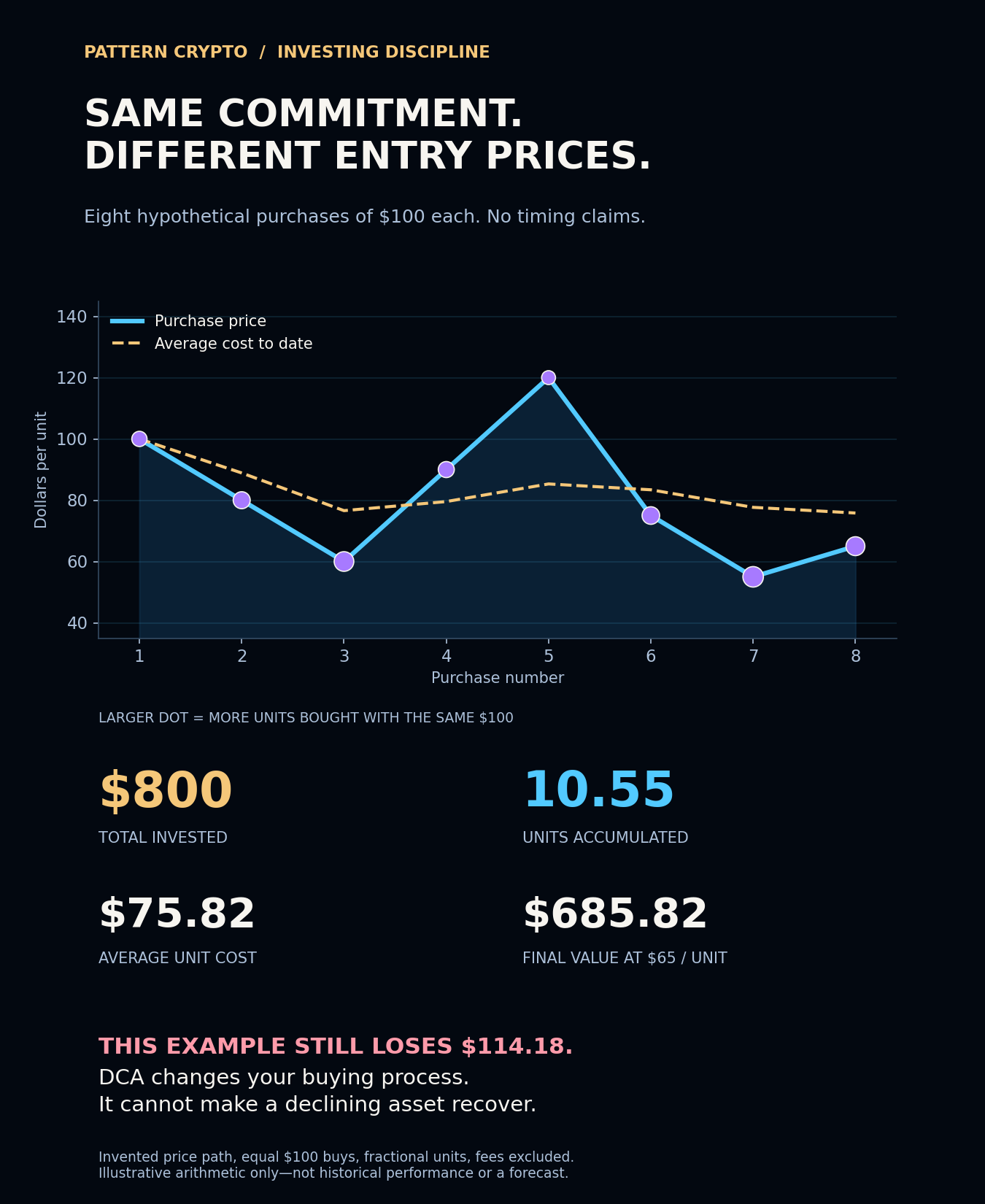
Purchase prices: $100, $80, $60, $90, $120, $75, $55 and $65. Total invested $800. Units accumulated 10.5519. Average cost $75.82. Final value at $65 per unit is $685.82: a loss of $114.18 before fees. Dots scale with units purchased; the dashed line is cumulative average cost. Hypothetical, not historical performance.
For a fundamentals-focused crypto approach, Bitcoin and Ethereum are natural starting points for research because of their long operating histories and distinct monetary and network roles. That is an editorial starting point, not a guarantee of safety or a claim that either is cheap. Solana can be studied separately as a platform thesis with a shorter history and different risks. Owning several crypto assets is still concentrated exposure to one volatile sector.
A recurring buy cannot repair a broken investment thesis. Understand why demand might persist, how supply changes, how the network is secured, and why its token should capture value. An established name offers more history to examine; it does not prevent permanent losses.
Set an overall crypto exposure limit before choosing a weekly or monthly amount. Keep essential spending and emergency money outside that budget. Avoid borrowing to maintain a schedule. Compare fees and spreads, because small frequent purchases can be costly, and think through custody before accumulating a meaningful balance.
Suppose an investor makes three hypothetical $100 purchases at prices of $100, $50, and $100 per unit. They acquire 1, 2, and 1 units: four units for $300, averaging $75 per unit before fees. At a final market price of $60, those units are worth $240—a $60 loss. Buying regularly improved the average entry relative to the first price; it did not guarantee a profit.
Spreading an existing cash sum over time leaves some money uninvested. That can soften initial exposure during a decline but lag an immediate purchase during a rising market. Investing new income as it becomes available is different: there was no earlier lump sum waiting to be deployed. DCA is a method for managing decisions and entry timing, not a universal return advantage.
Choose periodic reviews for affordability, portfolio concentration, fees, and whether the underlying thesis still holds. A price decline alone does not settle that question. A security failure, changed token economics, or a genuine need for the money can justify revisiting the plan.
It cannot prevent a prolonged collapse, protect against exchange or wallet failures, or make an unsuitable asset suitable. Continuing to buy something that never recovers can compound the loss. Discipline includes knowing when the assumptions have changed.
Background sources: FINRA — The Benefits and Limitations of Dollar-Cost Averaging (May 19, 2026). Crypto selection, risk framework, and numerical illustration are Pattern Crypto analysis. Reviewed September 18, 2026.
Prepared with AI assistance. Editorial preferences are opinions, not performance forecasts. The editor holds crypto assets discussed on this site, which can create bias. Assess affordability, concentration, and the possibility of permanent loss.
Memecoins, new launches, rug pulls, and the difference between an exciting chart and a survivable risk.
A new token can appear to offer everything an established asset cannot: a tiny price, a dramatic story, and the possibility of an enormous return. It also offers less history, uncertain liquidity, and more room for insiders to control the outcome. Not every new project is fraudulent, but novelty is not evidence of value. A low price per token does not mean a low valuation when supply is enormous.

Memecoins often depend heavily on attention, community enthusiasm, and a future buyer paying more. Those forces can produce extraordinary rallies and equally destructive reversals. A rising quote is not proof that you can sell a meaningful position at that price.
A rug pull can involve insiders withdrawing trading liquidity, exploiting privileged token controls, or abandoning a project after collecting buyers’ money. A malicious contract may allow purchases while restricting sales, create additional supply, or impose punitive transfer charges. A pump-and-dump uses promotion to attract buyers before insiders sell into the demand. These mechanisms differ, but the result can be the same: late buyers hold an asset they cannot exit without devastating losses.
Even without fraud, thin markets, concentrated ownership, and scheduled token unlocks can overwhelm demand. An honest project can fail. A polished website, celebrity mention, exchange listing, or audit badge is not a promise that your money is protected.
Who controls the supply and contract permissions? Can insiders change fees or restrict transfers? How much genuine exit liquidity exists? When can large allocations unlock? What did an audit actually cover? Are promoters being paid? If those answers are missing, urgency is a reason to step back. Locked liquidity and relinquished permissions may address particular risks, but neither proves an investment is safe.
Pattern Crypto’s editorial preference in this category is Dogecoin, the original meme coin. Its long public history, recognizable community, and open-source payment network make it a more understandable proposition to us than a newly launched imitation. That is a preference, not an objective ranking of future returns or a recommendation that everyone needs meme exposure.
DOGE can still suffer extreme drawdowns. Its ongoing issuance and dependence on demand matter, and familiarity does not make an inflated purchase price sensible. Native Dogecoin is also different from an unrelated token borrowing its name or logo.
Anyone choosing to speculate should treat the entire amount as expendable, avoid leverage, and keep it separate from essential savings. Do not increase the stake simply to recover a loss. A small successful test trade cannot prove a contract will remain sellable. Never disclose a recovery phrase or approve a wallet transaction you do not understand.
There will always be another chart that looks obvious afterward. The goal is to preserve the ability to invest tomorrow. Missing a rally costs an imagined gain; a rug pull can cost money you already had.
Background sources: Dogecoin — Official project overview and Dogepedia. FINRA — Avoiding Pump-and-Dump Scams (September 9, 2026), background on promotional manipulation in stock markets. Token-specific risk explanations and the Dogecoin preference are Pattern Crypto analysis. Reviewed September 18, 2026.
Prepared with AI assistance. Editorial preferences are opinions, not performance forecasts. The editor holds crypto assets discussed on this site, which can create bias. Assess affordability, concentration, and the possibility of permanent loss.